
A few weeks ago, I posted a question on LinkedIn that stirred the pot.
If you’re a candidate, how would you feel if a company called someone you didn’t list as a reference?
The reaction wasn’t one-sided. A hundred+ comments later, what I walked away with wasn’t a clean answer. It was a much more layered conversation about trust, ethics, consent, and the unwritten rules of professional reputation.
I’ll give you the high-level rundown.
What Started the Convo: Brian Halligan’s Playbook
The conversation was sparked by an episode of Lenny’s Podcast featuring Brian Halligan, co-founder of HubSpot. Halligan shared that he coaches leaders to conduct what he calls “blind references,” aka reaching out to people who weren’t provided by the candidate. The idea is to find someone you trust, who has direct experience with that person, and get the scoop.
He also shared a few of his favorite questions to ask:
- Would you enthusiastically rehire this person?
- On a scale of 1–10, how likely are you to try to hire them again?
- Were they top 1% of employees? Top 10%?
These aren’t soft, even objective questions. It’s a straight “yes” or “no”. And from a hiring perspective, that’s exactly his point.
The Case For Backdoor References
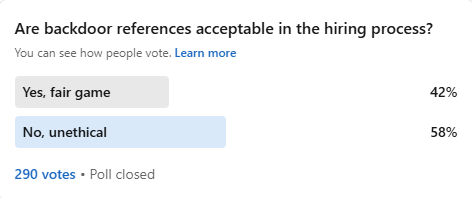
Before diving in, I ran a poll. The result? Almost perfectly split, with the edge taking that the practice was unethical.
Let’s be honest: backdoor references have always existed. Long before LinkedIn made professional networks searchable, people in tight-knit industries were picking up the phone and calling someone they knew who had worked with a candidate. Maybe at an industry conference or a happy hour. It happened quietly and informally.
What HubSpot’s approach does is formalize something that was already happening. And there’s a argument that formalizing the process, with consistent questions, structured criteria, and trusted sources is actually more fair than the ad hoc version.
As one commenter, Daryl Daley, put it bluntly: “You don’t get to control your reputation. You only get to build it. And if you’re worried about what people will say when you’re not in the room, the problem isn’t the reference check. It’s you.”
There’s something worth sitting with there. Candidates do their own due diligence on potential employers, like reading Glassdoor reviews, calling former employees, and checking the founder’s reputation on social media. The information-gathering is a two-way street. Why would we expect the hiring process to be any different?
For roles with significant leadership responsibility, influence, or authority, the risk of a bad hire are enormous. A single poor fit at the senior level can cost a company not just dollars, but team morale, retention, and months of rebuilding. If backdoor references give hiring leaders a more complete picture, it’s hard to argue they shouldn’t use every ethical tool available.
The Case Against…..And Why It Deserves to Be Taken Seriously
Here’s where it gets a bit complicated.
First, the consent problem. A background check legally requires candidate consent. Formal reference checks, where the candidate provides the names, are understood by candidates to be part of the process. But a backdoor reference sits in this grey zone. The candidate hasn’t agreed to it. They can’t provide context of the history and relationship. They can’t flag that the person being contacted has a complicated, nuanced history with them, perhaps a competitive axe to grind. Or, simply doesn’t have enough visibility into their actual work.
Recruiter Jessica Johnson made this point directly: “Without consent from the candidate, you have only the say-so from someone who may or may not have a vested interest in skewing your opinion, without the benefit of the candidate providing context.”
This is a major issue. People have stories from their professional relationships. A former manager who felt threatened by a high performer. A peer who didn’t get the promotion they wanted. A colleague who simply never clicked with the candidate personally. None of this context gets surfaced when you go around the candidate.
The risk to current employment. Several commenters raised the scenario that concerns most people: what if the candidate is currently employed, and the blind reference inadvertently puts that at risk? Matthew Wohl described it as “highly unethical” for precisely this reason. If word gets back to a current employer that someone is being quietly vetted elsewhere, the consequences can be real and immediate.
The quality of the information itself. Talent acquisition specialist Keri Tietjen Smith raised a pointed question about defensibility: “Unless you’ve directly managed the person, or been in a client relationship with them, you’re not really in a position to rating them.” A peer who didn’t work closely with that person day to day or a former colleague’s vague recollection isn’t going to be as strong as a coworker or manager.
The Middle Ground?
Reading through the range of responses, a more nuanced thought was gven.
Relationship context matters enormously. Copywriter Jade McDowell shared that having a blind reference done on her didn’t bother her, “it also helps me keep the MO of be a good person to everyone, you never know who is going to play a part in your history.” But she noted the contact wasn’t a supervisor. There’s a difference between a hiring manager reaching out to a mutual connection who genuinely knows your work, versus cold-calling someone scraped from your LinkedIn connections.
As another commenter, Jessica Johnson, framed it: “If the hiring manager had a long previous working relationship with a former coworker of mine, I wouldn’t be surprised if they asked what I was like to work with. But if they just skimmed my LinkedIn connections and called a random former coworker, I would feel that was unnecessarily invasive.”
That difference between an organic network versus a manufactured contact list is where most people’s ethical radar starts to calibrate.
The nature of the questions matters too. Marketing executive Breana Jones offered a useful framework: “If they want to know about my character or what it’s like to work with me, sure, ask anyone. But if you want to know if I’m great at my job, I want you to ask someone who knows enough about what I do to speak on it with expertise.”
Backdoor the reference? HR leader Jenelle Yeh made the point that if you’re going to take someone’s word for a candidate, you might also want to reference-check your source. The blind reference assumes the person providing the feedback is trustworthy, but that assumption itself is unvetted.
So Ethical or not?
Here’s my read after watching this conversation play out:
Backdoor references aren’t going away. In small circles, especially, executives and leaders will call up a trusted contact to get the real story on a candidate — that’s just how it works. What can be influenced, if not fully controlled, is how it’s done. Talent acquisition professionals, and even the people being asked, can push back: name the bias, flag the ethical concerns, and encourage the person asking to think twice about what they’re actually gathering and why.
For candidates: try to avoid setting those bridges aflame, and remember that your reputation travels further than your resume.
At the same time, organizations that use backdoor references without guardrails are playing with fire themselves, legally, and ethically. The quality of an unvetted, unsolicited reference is genuinely questionable. And if it puts them in a dicey spot if a decision that later gets challenged, “someone I trusted told me” isn’t a defensible position.
The better version of this practice is contacting trusted network who have real, substantive exposure to the candidate’s work. Objective questions, not “yay” or “nay,” would you work them again. And of courese, always being mindful of their current employment status.
Robin Sullivan, who spent 16 years in recruiting, captured the practical line most professionals intuitively draw: “As long as nobody’s calling folks at a current employer without consent, everyone else is fair game.”
Calling someone’s current boss is a dummy move by an employer.
Maybe the bigger conversation isn’t about who you’re calling. It’s about what you’re asking, and whether the person on the other end is actually in a position to give you an objective, informed answer. Better questions. Better sources. That’s where better hiring lives.
- The Backdoor Reference Check: Fair Game or Foul Play?
- How to Use AI to Discover Where You’re Actually Competitive in the Job Market
- How to Job Search Like a Headhunter (A Recruiter’s Playbook)
- Why Your 2026 Job Search Needs an Interactive Portfolio Chatbot
- How to Modernize Your Resume for the AI Era